

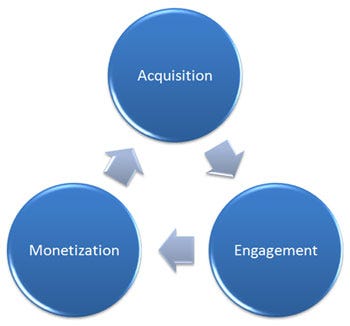
I've found across the many products I've managed that I ultimately end up developing at least three key dashboards that I review in detail every week. They help me have a constant pulse on how well the product is performing against our objectives and reviewing them on an ongoing basis helps to build my own intuition for what's ultimately going to move the needle in the right direction.
Those three dashboards are acquisition, engagement, and monetization.
Acquisition
The acquisition dashboard captures how you are doing in terms of attracting new users to your product. If you have a marketing site for your product, this dashboard captures the funnel from homepage or landing page to signed up user. This helps you understand the drop-off points of users that are making their way to your marketing site but not fully to a signed up user.
The other equally important part of your acquisition dashboard is providing insights into each of your acquisition channels and their performance relative to past performance as well as against your other channels. The specific metrics captured will depend on the specific channels you're tracking. Paid advertising might include impressions, clicks, CTR, and signup conversation rates. SEO may include keyword ranking, organic traffic to content pages, and sourced signups. In-product viral acquisition might include invites sent, invites accepted, and the funnel in-between. The point is to understand and instrument each of the key drivers for each respective channel.
You'll want to also ensure you can compare the relative performance of one channel against the other. Early on this can be a simple dashboard covering signups sourced per channel. Eventually you'll want to understand the ultimate value of those signups per channel as you'll likely see the quality and value of each signup depends on it's source. One way this is often done is on an LTV basis of the ultimate value of the customer. And in more sophisticated cases, you'll need to incorporate multi-channel attribution realizing that users often have multiple touch points across your acquisition efforts before they ultimately convert to a signed up user and multi-channel attribution gives you the tools you need to understand the relative weighting of each channel.
For each of the captured metrics, I find it helpful to show week-over-week performance and ultimately year-over-year performance when you have it. Year-over-year helps to ascertain seasonality so you can understand whether there has been a secular shift in the metric or simply the regular rhythms of seasonality.