

Over the past year at LinkedIn I developed a strong appreciation for using Net Promoter Score (NPS) as a key performance indicator (KPI) to understand customer loyalty. In addition to the standard repertoire of acquisition, engagement, and monetization KPIs, NPS has become a great additional measure for understanding customer loyalty and ultimately an actionable metric for enhancing your product experience to deliver delight.
I wanted to share the best practices I've learned for implementing an NPS program within an organization to get the most out of this KPI for driving more delightful product experiences.
The Origin of NPS
Net Promoter Score (NPS) is a measure of your customer's loyalty, devised by Fred Reichheld at Bain & Company in 2003. He introduced it in a seminal HBR article entitled The One Number You Need to Grow, which I highly recommend anyone serious about NPS to read in detail. Fred found NPS to be a strong alternative to long customer satisfaction surveys as it was such a simple single question to administer and was able to show correlation between NPS and long-term company growth.
How NPS is Calculated
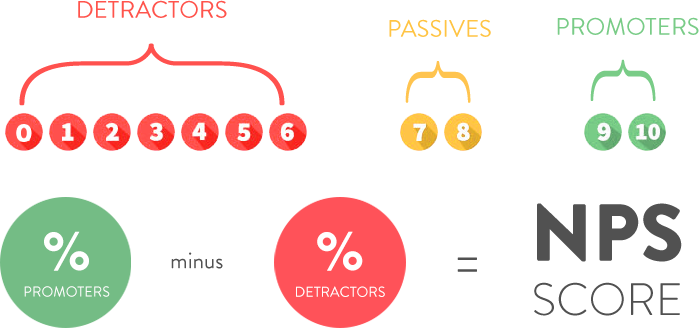
NPS is calculated by surveying your customers and asking them a very simple question: "How likely is it that you would recommend our company to a friend or colleague?" Based on their responses on a 0 - 10 scale, group your customers into Promoters (9-10 score), Passives (7-8 score), and Detractors (0-6 score). Then subtract the percentage of detractors from the percentage of promoters and you have your NPS score. The score ranges from -100 (all detractors) to +100 (all promoters). An NPS score that is greater than 0 is considered good and a score of +50 is excellent.
Additional NPS Questions
In addition to asking the likelihood to recommend, it's essential to also ask the open-ended question: "Why did you give our company a rating of [customer's score]?" This is critical because it's what turns the score from simply a past performance measure to an actionable metric to improve future performance.
It's also helpful to ask how likely they are to recommend your competitor products or alternatives, so you can establish a benchmark for how your NPS score compares to others in your industry as there are substantial differences in scores by product category. Keep in mind though that these results are biased since you are sampling your own customers for these benchmarks instead of a random cross-section of potential customers, including those who have chosen competitive solutions.
Many ask additional questions to understand additional drivers of the customer's score. These are optional as while they add value in understanding the results, they add complexity which reduces the response rate, so you need to consider the trade-off of doing so.
Collection Methods
NPS scores for online products are typically collected by sending the survey via email to your customers or through an in-product prompt to answer the survey. To maximize response rates, it's important to offer the survey across both your desktop & mobile experiences. While you could create such a collection tool in-house, I encourage folks to use one of the NPS survey solutions out there that support collection and analysis across a variety of channels and interfaces, such as one offered by my wife Ada's employer SurveyMonkey.
One challenge with both email and in-product based survey methodologies is they tend to bias responses to more engaged customers as less engaged users are likely not coming back to the product nor answering your company's emails as frequently. We'll talk about potentially addressing this below.
Sample Selection
It's important to survey a random representative sample of your customers each NPS survey. While that may sound easy, we found cases in which the responses weren't in fact random and it became important to control for this in sampling or analysis. For example, we found strong correlation between engagement and NPS results. Therefore it was important to ensure your sample in fact reflects the engagement levels of your actual overall user base. Similarly, we found a correlation between customer tenure and NPS results as well, thus another key factor to ensure the customer tenure in the sample similarly matches that of your overall user base.